
- /
- Blog / Why is Humidity Tester an Important Instrument in Lab Testing?
Why is Humidity Tester an Important Instrument in Lab Testing?
.png)
07-4-2017
Quick Summary
Uncoated metal and many other raw materials can easily get damaged by corrosion and breakdown. The main cause of this kind of damage is humidity in the air. To study how materials react, manufacturers use a humidity tester inside a humidity chamber. This device helps recreate real-world moisture levels in a lab. It gives them a controlled environment to observe how their materials behave when exposed to humidity. This blog looks at how a humidity test chamber works. It also explains why such a tool is essential in today’s quality control labs. It shows which industries rely on humidity testing chambers to stop their products from failing because of moisture.
Introduction
Metal that has not been coated is prone to corrosion. The most common cause of corrosion is humidity in the air. The more moisture content in the air, the more protection is required for metal. This is why there arises a need to create an instrument called a humidity tester or humidity chamber. Humidity Chamber could easily simulate the weathering conditions and judge the response of metal to those conditions.
Every item behaves differently when it comes into contact with water. Metal gets rusty, paper becomes weak, and rubber might get too soft, and the paint can crack or fall off the surface it's supposed to cover. Because the amount of moisture in the air changes a lot depending on where you're and what time of year it is and how things are stored or moved, companies can't just hope their products will stay strong. That's why the humidity tester has become a very important tool in testing labs—it adds a sense of control to a part of the environment that is usually hard to predict.
What is a Humidity Chamber?
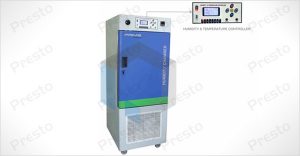
A humidity chamber is a lab instrument that creates controlled temperature and moisture conditions. A humidity chamber lets manufacturers see how raw materials and finished products might behave during real‑world use, storage, or shipping. A humidity chamber speeds up the effects of heat and humidity, so it helps spot changes or damage. This way, companies can find issues quickly instead of waiting months or years for natural exposure to show up.
How Does a Humidity Chamber Work?
A humidity chamber can create environmental conditions with controlled temperature and humidity. The chambers are equipped with heaters and fans. As soon as the heater raises the temperature, the fans distribute the heat uniformly throughout the chamber. Uniform heat distribution is very important so as to avoid any discrepancy in the results.
For generating humid air, there is a placement of an atomizer. This atomizer can be easily connected to a spray nozzle to control the water spray. Due to the high temperature in the chamber, the sprayed water tends to moisten the air. Humidity from 65% to 98% can be easily achieved. As the temperature of the heater decreases, the percentage of humidity also decreases. One important point to consider, humidity cannot be controlled but can be checked with a tester.
Quick Reference: Key Functional Elements
| Component | Function |
| Heater | Raises internal chamber temperature to the required test level. |
| Circulating Fans | Distribute heat uniformly to prevent result discrepancies. |
| Atomizer/Spray Nozzle | Generates moisture by spraying water into the heated air. |
| Humidity Range | Achieves 65% to 98% relative humidity. |
| Temperature-Humidity Link | Humidity level drops as heater temperature drops. |
.gif)
Presto Group's Humidity Chambers
At Presto Group, we make humidity chambers that are designed to give consistent results for this kind of testing. Presto has years of experience working with industries in India and around the world. Our humidity chambers are designed with heating systems, even airflow, and precise control over humidity levels. This helps manufacturers test their products with confidence. Whether you need a chamber for research and development or a bigger one for full production quality control, the range of testing equipment from Presto Group is built to meet global testing standards. These instruments are built to last. Deliver reliable performance for many years.
Why is a Humidity Tester Important in Lab Testing?
A humidity tester helps prevent problems before they happen. It does not wait for a material to fail in the field—like when metal parts get corroded, paint cracks, or packaging weakens. Instead, it lets manufacturers find these weaknesses early during research and development or quality control. This gives companies a chance to fix issues ahead of time.
- Avoid costly product recalls and field failures.
- Select the right raw materials and protective coatings.
- Meet industry and export compliance standards.
- Build long-term product reliability and customer trust.
What are major industries that need a humidity chamber?
Any product whose raw material gets affected by humidity needs this testing instrument. To name a few;
- Automotive – It is considered as the biggest user of this testing chamber. Automotive parts are made up almost every type of raw material which includes, metal, plastic, paint, rubber, polymers. Although, assemblers do not require it. Manufacturers of the body parts and spares cannot work efficiently without it.
- Paints and coating – This industry vertical need to perform various tests on the raw materials. As we know that paints and coatings usually work as protective layers for different products. So, if the protective layer does not have the ability to withstand the severe humid environments, how would it protect the surface beneath?
- Rubber – It shows a volatile behaviour in different So, to make the rubber withstand the harsh working conditions, environment and storage conditions, etc. it becomes imperative to conduct a humidity test on the raw form of rubber.
- Paper – It tend to lose its properties if exposed to moisture. So, to check the suitability of the paper for the application and environment; humidity chamber plays a crucial role.
- Packaging – This industry utilises different forms of packaging materials like paper, corrugated sheets, boxes, wooden boxes, polymers. How these materials will respond to different transportation conditions makes it necessary to install a humidity testing lab. Especially in overseas transportation, it is crucial to judge how the consignment packaging would respond to the humid
Choosing the Right Humidity Testing Chamber
When choosing a humidity testing chamber, manufacturers need to think about important details. The first is the range of humidity and temperature the chamber can handle. It must be able to meet the needs of the product being tested. Then there's the size of the chamber. It should be large enough to fit the product comfortably while still allowing airflow and control. Uniformity is another factor. The heat and moisture must be spread evenly throughout the chamber to avoid uneven readings. Lastly, the chamber must follow industry standards. This ensures that tests are valid and results are accepted by regulators or clients. A good chamber gives data every time. That helps in checking quality inside the company and supports certification efforts outside.
Conclusion
Humidity can affect materials at every stage from storage to use. Much moisture can lower quality, make materials weaker, and cause products to fail sooner. A humidity tester helps manufacturers spot these problems early and prevent failures.
Industries such as automotive, paints and coatings, rubber, paper, and packaging use humidity chambers to simulate conditions. They check how materials perform over time.
If you need a humidity testing solution for your lab, contact Presto Group for help.
Call us at +91 9210 903 903 or fill out our enquiry form to get a quick quote.
FAQs
Q1. What is the difference between a humidity tester and a humidity chamber?
"A humidity tester" usually means the tool or feature that measures and keeps track of how much moisture is in the air. A humidity chamber is the system that creates and manages both temperature and humidity for testing.
Q2. Can humidity be controlled directly inside the chamber?
No. Humidity cannot be directly controlled. Humidity is created by controlled temperature and water spray from the atomizer. Humidity can then be checked with the tester.
Q3. Why is uniform heat distribution important in a humidity chamber?
Uniform heat distribution means that every part of the sample inside the chamber has the same temperature. This helps make sure there are no differences in the results. It also ensures the test gives accurate readings. When the heat is even, no part of the sample becomes too hot or too cold. That way, the test outcome remains reliable.
Q4. Is humidity testing necessary for packaging materials used in overseas transport?
Yes, it is especially important for shipping, as it helps figure out how packaging materials will stand up to wet air during long trips. The way packaging materials deal with air during long trips is very important when sending things across the ocean. It is especially important for shipping because it shows how well the packaging materials can handle wet air during long trips.
Recent Blogs
- Industrial Leak Testing: Methods, Technologies, Benefits, and Industry Applications
- Autoclave in Laboratories and Industry: Principle, Procedure, Components, and Applications
- Uses of BST in Packaging, Paper, and Corrugated Box Testing
- Leak Testing Procedures for Packaging Materials in Accordance with ASTM D6653
- Bursting Strength Testing: ASTM, ISO, and TAPPI Standards for Packaging Evaluation